Unit 5 · Interactive muscle map & synthesis
Where the five D's stop being a list and become one decision
You have covered mechanism, diagnosis, dose, depth, direction, distribution and muscle antagonism as separate ideas. Every treatment applies them simultaneously, to a muscle that sits in a system of opposing forces. This unit gives you the map that holds all of it in one place, and then asks you to plan with it.
Framing
A reference tool, not a revision aid
The map below is built from the same frozen clinical content you have worked through — the dose table from Unit 2, the depth guidance from Unit 3 and the antagonist relationships from Unit 4, assembled into one surface.
Use it the way you would use it chairside: start from the muscle you intend to treat, read its plane and its indicative dose range, then follow its antagonist link and look at what you are about to leave unopposed. That second step is the one field testing showed practitioners skip.
Across all four preceding units, one instruction recurs in every clinical scenario — corrugator and frontalis, frontalis and brow position, DAO and levator anguli oris. Name the single principle those scenarios are all expressions of.
Hold your answer before you open this. The value is in having committed to a mechanism first.
Never treat a muscle in isolation without actively considering the effect on its anatomical antagonist and neighbouring muscles. Document your assessment of the full muscle system, not just the muscle you are treating.
This is why the map carries antagonist links rather than presenting eight independent profiles. A lookup table answers "what dose". A systems tool answers "what happens to the balance", which is the question that produces the lateral brow elevation, the worsened ptosis and the partial lower-face result described in Unit 4.
Learn · Interactive muscle map
Eight muscles, one system
Select a muscle zone on the diagram, or a muscle from the index, to open its clinical profile — type, depth and plane, indicative BTX-A reference unit range, injection points, antagonists and the key clinical caution. From within a profile, select an antagonist to highlight it on the diagram while the profile stays open, so you can see both sides of the balance at once.
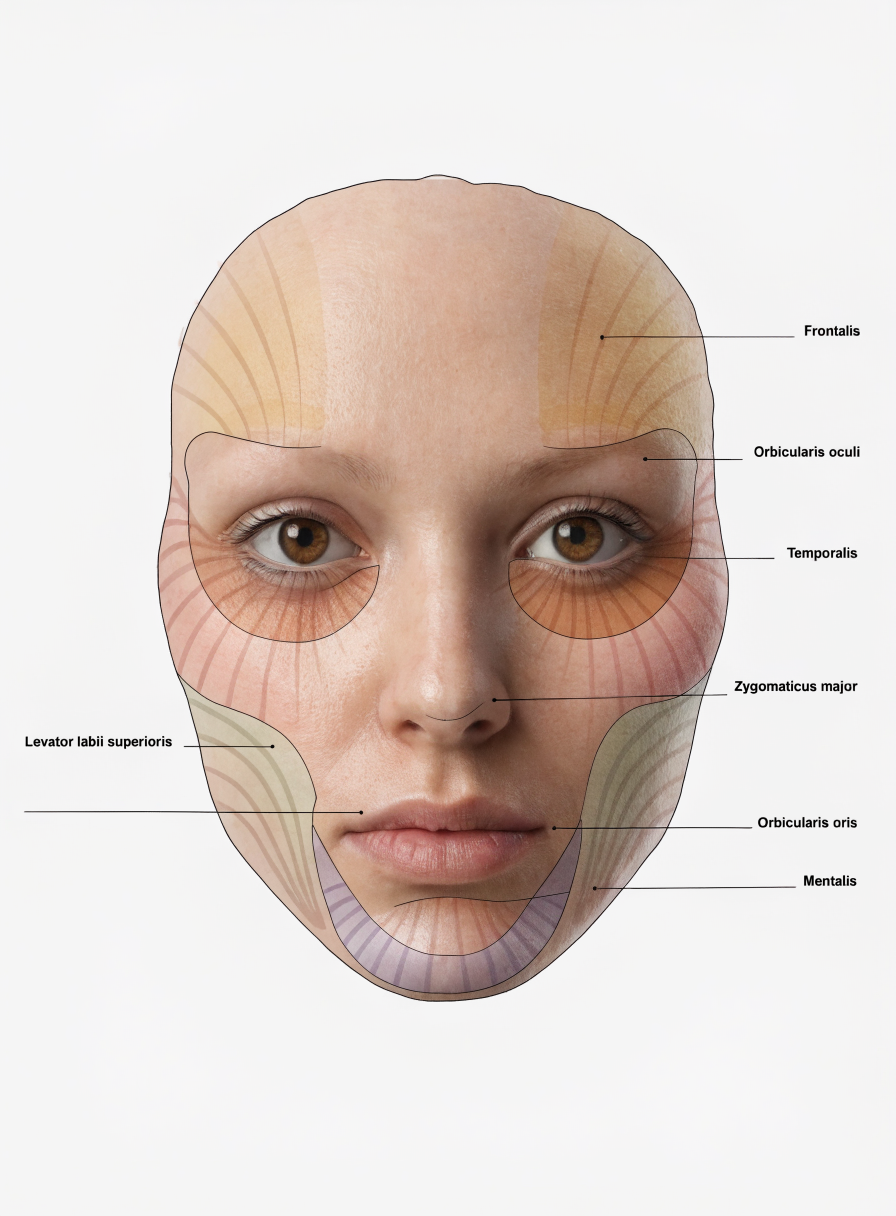
Select a muscle to open its clinical profile. All unit figures are indicative BTX-A reference units.
- Elevator
- Depressor
- Sphincter
Zone outlines indicate the approximate territory of each muscle for orientation. They are not injection point markers and are not a placement guide. Injection point counts and the source placement guidance are given in each profile.
Filter to Elevator and one muscle remains. That is not a gap in the map — the dose reference table contains a single elevator, the frontalis, and Unit 4 states plainly that it is the sole brow elevator. Every other treatable muscle on this map pulls downward. The upper face has one lifter and several depressors opposing it, which is the structural reason conservative frontalis dosing matters more than conservative glabellar dosing.
The levator anguli oris appears in the DAO profile as an antagonist but has no zone on the map and no indicative range in the source dose table. That is deliberate. It is an assessment target rather than a treatment target in this module: Unit 4 requires you to establish its strength before relaxing the DAO, because relaxing a depressor whose opposing elevator is also weak produces only partial improvement.
Every unit figure in every profile on this map is an indicative BTX-A reference unit range. Botulinum toxin type A products are Schedule 4 Prescription Only medicines in Australia and must be prescribed by an authorised prescriber. Formulations use distinct, non-interchangeable unit systems — reconcile every figure against current product-specific prescribing information before use.
When treating the depressor anguli oris (DAO) for downturned oral commissures, the most important anatomical structure to avoid is:
Select an option to commit. The reasoning appears afterwards.
The dose guidance for downturned mouth corners is explicit: palpate the DAO carefully lateral to the commissure and avoid the orbicularis oris, because diffusion into it carries an asymmetric lip droop risk. The DAO is a deep muscle lying beneath more superficial layers, so an injection placed too superficially at this site lands in exactly the structure you are trying to spare.
This is a distribution decision as much as a depth decision. Clinically significant diffusion extends approximately 1 to 1.5cm from the depot, and the orbicularis oris sits well inside that radius from a commissure injection. Where precision is critical — and the DAO is named as one of those sites — a more concentrated preparation keeps the product where you put it.
Learn · Module synthesis
The five D's as a single sequence
Applied consistently, the five D's reduce variability, support clinical reasoning and build a defensible treatment rationale. They are presented as a numbered framework because that is how they are learned. They are executed as one continuous decision, because depth without direction puts product in the wrong plane, and dose without distribution puts the right quantity in the wrong territory.
| Principle | The decision it governs | What goes wrong when it is skipped |
|---|---|---|
| 1 — Diagnosis | Structured dynamic and static muscle assessment before every session, graded 1 to 4 and documented. | Compensatory activity is read as overactivity. A patient using frontalis to hold the brow up is treated as though the frontalis were the problem. |
| 2 — Dose | Unit selection informed by grade, area, anatomy, treatment history and desired outcome. All ranges are indicative BTX-A reference units. | A range is applied as a prescription. Starting conservatively and adjusting at review is the safer position. |
| 3 — Depth | Matching the injection plane, and the needle length, to the muscle rather than to preference. | A superficial corrugator injection sits above the target. A superficial DAO injection reaches the orbicularis oris. |
| 4 — Direction | Entry point, bevel orientation and trajectory, chosen around the structures that must be avoided. | A medial glabellar approach meets the supratrochlear vessels rather than avoiding them. |
| 5 — Distribution | Point count, extrusion volume and dilution, set against a diffusion radius of approximately 1 to 1.5cm per depot. | Coverage falls short across a broad muscle, or spread reaches an adjacent structure such as the levator palpebrae superioris. |
The five D's describe the muscle you are treating. The interconnected system describes what happens next. A plan that satisfies all five and still ignores the antagonist will produce a technically correct injection and a clinically disappointing result — which is precisely the pattern behind lateral brow elevation after an isolated glabellar treatment.
Distribution and depth are the two principles that interact most closely with dilution. A more dilute preparation diffuses more widely and may reduce the number of injection points required across the platysma or frontalis. A more concentrated preparation remains localised and is the appropriate choice at the DAO, procerus and corrugator origin, where precision is critical. The same dose can therefore behave very differently depending on the volume it arrives in.
Sometimes the correct decision is not to treat all interconnected muscles. A patient seeking softening of dynamic forehead lines without loss of expressivity, or one with brow asymmetry driven by unilateral corrugator dominance, may be better served by a targeted treatment than by a whole-face approach. Assessing the system is mandatory. Treating all of it is not.
A patient presents requesting treatment for downturned oral commissures. On dynamic assessment the DAO is strong bilaterally, the levator anguli oris is of adequate strength, and there is visible chin dimpling on animation. You plan to treat the DAO and the mentalis in the same session. Applying the five D's, the combination of decisions that best supports this plan is:
Select an option to commit. The reasoning appears afterwards.
Each element of the correct option is a different D doing its work. Diagnosis established that the levator anguli oris is adequate, which is what makes DAO relaxation worth doing — with a weak or hypotonic LAO the same injection produces only partial improvement. Depth separates the two muscles: the DAO lies beneath more superficial layers and is palpated and injected deep, while the mentalis is a mid-depth injection into the muscle belly. Dose holds each within its indicative BTX-A reference range, and distribution chooses a more concentrated preparation because the orbicularis oris sits inside the diffusion radius of a commissure depot.
The reason this reads as one decision rather than four is that the levers conflict. Choosing a more dilute preparation to reduce punctures would widen spread toward the structure you are protecting. Choosing a superficial plane for patient comfort would place product in it directly. The plan holds together only when depth, dose and distribution are set against each other rather than in sequence — and it holds together at all only because the antagonist was assessed before any of them were chosen.
Unit 5 summary
Clinical takeaways
- The map is a planning surface, not a lookup table. Every profile carries its antagonist because the treatment decision is incomplete until you have looked at what the relaxation leaves unopposed.
- Depth is muscle-specific and is not negotiable. The corrugator and the DAO lie beneath more superficial layers and require palpation and a needle length matched to the muscle. The frontalis, orbicularis oculi, nasalis and platysma are superficial. The mentalis is mid-depth into the belly.
- Distribution decides where the dose actually acts. Diffusion extends approximately 1 to 1.5cm from each depot. Dilution, extrusion volume and point count are how you control that radius, and they are the levers that protect adjacent structures.
- Every figure on this map is an indicative BTX-A reference unit range. Botulinum toxin type A products are Schedule 4 Prescription Only medicines with distinct, non-interchangeable unit systems. Reconcile against current product-specific prescribing information before use.
- Assess the whole system; treat the part that warrants it. Documenting your assessment of the full muscle system is unconditional. Treating all of it is a separate clinical judgement, and restraint is frequently the correct one.
This module is in draft. If anything here reads as unclear, incomplete or clinically contestable, record it in the review form.